A good answer might be:
Yes---if the signals represented a singer's voice, the noisy signal would sound, er.. well... noisy. After just one copy, information has been lost.
Advantages of Binary 3: Flawless copies can be made.
Review the advantages of binary:
- Simple; easy to build.
- Unambiguous signals (hence noise immunity).
- Flawless copies can be made.
- Anything that can be represented with some sort of pattern can be represented with patterns of bits.
Flawless copies can be made: The receiving end of the signal is only interested in the binary values. All it has to do it check if the signal is above or below the threshold. This can be done perfectly (as long as the noise is not too great.) For example, here is the noisy signal with the "on"/"off" values recovered from it:
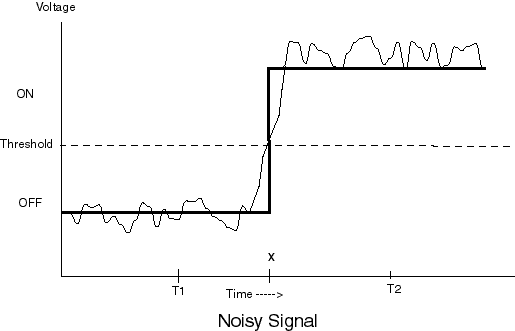
This process can occur as many times as needed with a perfect copy made each time. This is essential in a computer system, where bit patterns (patterns of one and zero, or on and off) are copied back and forth between the processor and memory millions of times a second. The copies have to be perfect.
QUESTION 8:
Something might be wrong here. What if you need to know if the signal is "on" or "off" at the time "x" in the picture. A slight bit of noise will make this ambiguous. How can this be handled? (Hint: do you need to know the value of the signal at all times?) Click Here after you have answered the question