A good answer might be:
Not really.
Picture of the Relations
Perhaps a picture is needed. Clouds represent class definitions, and rectangles represent objects. The interface is a dotted rectangle (becuase it is neither a class nor an object.) The main() method is static, also represented with a dotted rectangle.
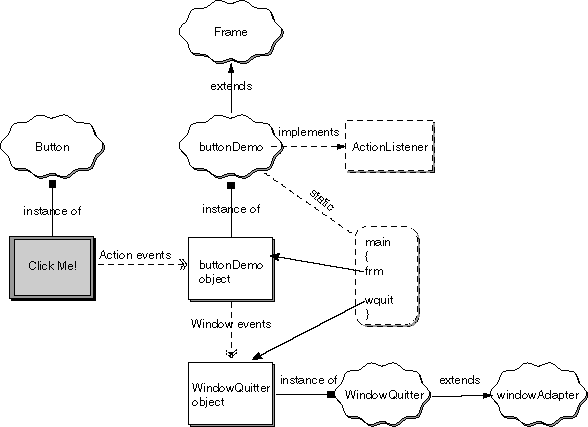
Look back at the example program as you study the diagram.
- The class buttonDemo extends the class Frame.
- The main() method is static, so is not part of any object.
- Main contains two reference variables:
- frm, which refers to a buttonDemo object, and
- wquit, which refers to a WindowQuitter object
- Main contains two reference variables:
- There is a single buttonDemo object, which will be the frame the users sees on the monitor screen.
- There is a single Button object (which will appear inside of the frame.)
- Events from the button are sent to the buttonDemo object.
- The buttonDemo object was registered as a listener for Action Events.
- The buttonDemo class implements ActionListener.
- Events from the frame are sent to the WindowQuitter object.
- The WindowQuitter object was registered as a listener for Window Events.
- The WindowQuitter class extends WindowAdapter.
QUESTION 13:
(Thought question: ) Do you have to use the "close button" of a frame to quit the program? Could an ordinary Button be used?
Click Here after you have answered the question